
The AI Shift in Product Management
November 21, 2024
Artificial intelligence is changing the landscape of product management. Instead of relying on intuition, product managers are now empowered to make decisions based on hard data. This shift toward data-driven strategies provides a crucial competitive advantage.
Understanding the Impact of AI on Product Decisions
Historically, product management decisions often relied on experience and gut feelings. Predicting user behavior or prioritizing features involved a degree of guesswork. AI-powered tools now offer real-time data and predictive analysis.
This provides product managers with a clearer understanding of customer needs. The result? More accurate product roadmaps, more effective feature development, and ultimately, more successful products.
Platforms like Amplitude and Mixpanel offer detailed user journey metrics, supporting data-driven decision-making. This integration of AI into product management is transforming the field, moving from intuition to data-driven insights. McKinsey research suggests AI could add $4.4 trillion in productivity growth through corporate applications.
As AI continues to optimize processes and analyze large datasets, product managers need to develop data science and technical skills. For more detailed information on AI's impact, check out this resource: Why AI Will Define Product Management
The Evolving Role of the Product Manager
With the increasing importance of AI, the product manager's role is also evolving. Product managers now need to be proficient in interpreting AI-driven insights.
This involves developing a stronger understanding of data analysis, machine learning principles, and the application of AI to specific product challenges.
Key Areas Where AI is Making a Difference
AI is impacting many aspects of product management:
User Research: AI can analyze large amounts of user data to identify patterns, preferences, and pain points.
Competitive Analysis: AI provides insights into market trends and tracks competitor activity.
Product Roadmapping: AI helps prioritize features and predict the impact of development decisions.
Personalization: AI personalizes user experiences based on individual preferences and behavior.
By embracing these AI capabilities, product managers can significantly improve their workflow. Better decisions and products that truly meet user needs are the ultimate outcome. This isn't simply about adding another tool; it's a fundamental shift in how products are developed and succeed.
Essential AI Tools That Actually Deliver Results
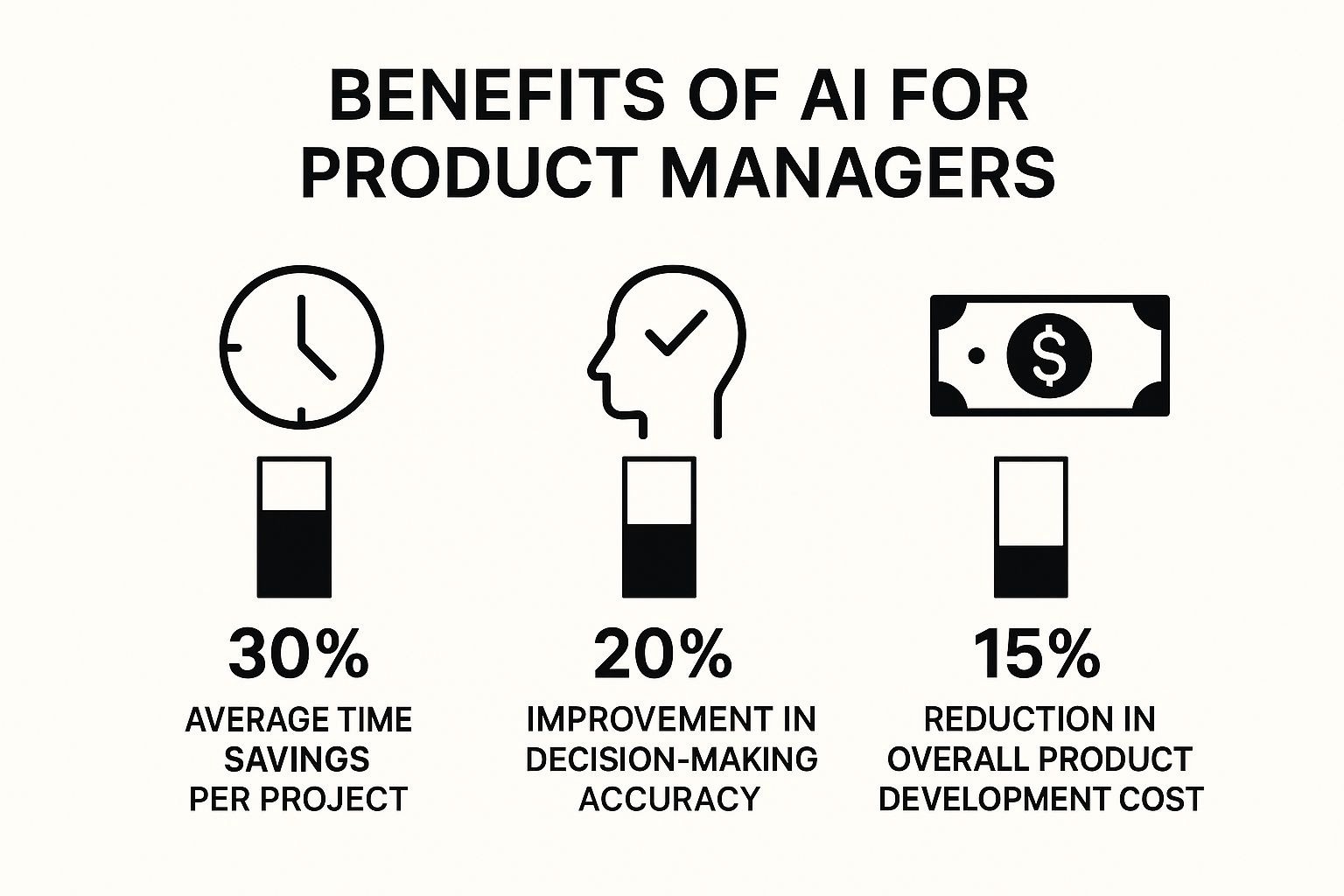
The infographic above illustrates the benefits of using AI in product management. It shows how AI can save time, improve decisions, and lower costs. Specifically, it highlights a 30% average time savings per project, a 20% boost in decision-making accuracy, and a 15% reduction in product development costs. This allows product managers to focus on high-level strategy and deliver better products more efficiently.
The number of AI tools available can be overwhelming. To simplify the selection process, concentrate on tools that address specific product management needs. Think about categorizing AI solutions based on their practical use cases, from automating user research to optimizing product roadmaps and improving stakeholder communication. For a deeper dive into this topic, check out this resource: Generative AI for Product Managers.
AI-Powered Tools for User Research and Analysis
Understanding your users is crucial. AI tools are great for automating user research and analyzing data. They can identify patterns, preferences, and pain points within large datasets. For instance, certain tools can automatically analyze user feedback from surveys and reviews, providing valuable insights into user sentiment and highlighting areas for product improvement.
Streamlining Product Roadmaps with AI
Product roadmaps need to be flexible. AI helps create dynamic roadmaps that adapt to changing market conditions and user feedback. This leads to more accurate delivery forecasts and better prioritization of features. Plus, AI can identify potential risks and dependencies early on in development.
One key trend is the automation of repetitive tasks. By 2025, AI is expected to handle tasks like writing status updates, analyzing feedback, and creating documents, allowing product managers to focus on strategy and stakeholder alignment. Tools like BuildBetter can automate tasks like recording calls, extracting key insights, and generating documents—saving hours of manual work. This shift is important as the AI market expands at a CAGR of 35.9%. For more on future AI trends, see this article: Learn more about AI trends for 2025. Product managers need to adapt and learn to use these advancements effectively.
Enhanced Stakeholder Communication with AI
Clear communication of product updates and decisions is essential. AI can automate some aspects of stakeholder communication. This ensures consistent messaging and frees up product managers for more strategic conversations. AI can generate regular progress reports, summarize key findings, and even tailor communication to individual stakeholder needs. This results in improved collaboration and better-informed decisions.
The following table provides a comparison of some helpful AI tools for product managers:
Top AI Tools for Product Managers in Different Categories A comprehensive comparison of leading AI tools for product managers across different functional areas
Tool Name | Primary Function | Key Features | Pricing Model | Best For |
Product Roadmap Management | Auto-recording calls, extracting user signals, generating documents | Contact for pricing | Streamlining workflows, automating tasks | |
Product & Engineering Workspace | Spec-driven development, living codebase context, parallel AI agent execution, kanban board with real-time updates, two-way Linear/Jira sync, IDE integration via CLI and MCP | Varies by plan | Product and engineering teams running AI agents who need planning, execution, and visibility in one place | |
ChatGPT | AI Chatbot | Text generation, summarization, translation, question answering | Varies by plan | Research, content generation, communication |
From Gut Feeling to Data-Driven Product Decisions

This section explores how successful product teams use AI to improve their decision-making process. Instead of relying on intuition or gut feelings, they're embracing evidence-based strategies. This shift offers a practical framework for incorporating AI into your existing product workflow.
Analyzing Customer Data With AI
Top product managers utilize AI to analyze large volumes of customer data. This enables them to uncover hidden patterns and trends that might be missed using traditional analysis methods. For example, AI can reveal valuable insights into how different user segments interact with a product, highlighting key opportunities for personalization and improvement.
This granular level of understanding allows for highly targeted product development initiatives. It helps teams focus on the features and improvements that will resonate most with their users.
Identifying Market Trends and Competitive Intelligence
AI also plays a crucial role in identifying emerging market trends and providing valuable competitive intelligence. By tracking competitor activity and analyzing market data, AI can offer insights that inform important strategic decisions. This empowers product managers to anticipate market shifts and proactively adjust their product strategy, keeping them ahead of the competition.
Balancing AI Insights With Human Judgment
While AI provides powerful data-driven insights, it's important to remember the value of human judgment. Experience and intuition are still vital components of successful product development. Product managers need to develop the skills to interpret AI-generated data and combine it with their own expertise.
This blended approach, combining the analytical power of AI with human understanding, leads to the most effective decision-making.
Communicating AI-Driven Insights to Stakeholders
Sharing AI-driven insights with stakeholders, especially those who may be skeptical of these new technologies, is another important aspect of data-driven decision-making. Product managers need to effectively communicate the value proposition of AI and present the information in a clear and understandable way.
This often involves translating complex technical data into simpler terms that everyone can grasp. Building trust in the data and the AI tools themselves is essential for gaining buy-in from key decision-makers.
Determining Which Decisions Benefit Most From AI
It's important to recognize that not every decision requires AI intervention. Product managers need to determine which decisions benefit most from AI augmentation and which are better suited for traditional approaches. For example, strategic decisions involving long-term product vision might still rely heavily on human judgment.
However, tactical decisions around feature prioritization can greatly benefit from the insights provided by AI. By understanding both the limitations and advantages of AI, product managers can apply these tools strategically to maximize their impact. Tools like Devplan can help you incorporate AI into your product strategy by leveraging industry best practices. This ensures features are built efficiently and with fewer unforeseen issues. You can secure early access to Devplan during its beta to experience the benefits of AI-native development.
Reclaiming Your Time Through Strategic Automation
This section offers a practical guide to automating routine product management tasks. We'll explore how strategically integrating AI can free up your time, allowing you to focus on higher-level strategic initiatives. This involves pinpointing repetitive tasks suitable for automation and implementing workflows that maintain quality while minimizing manual effort.
Identifying Automation Opportunities
The first step is identifying time-consuming tasks. Many product managers are bogged down by repetitive activities.
Processing customer feedback
Feature prioritization
Competitive monitoring
Documentation
These are ideal candidates for AI automation. Automating these allows product managers to significantly boost their efficiency.
Implementing Automation Workflows
Leading product teams already use AI to automate various workflow aspects. For instance, AI-powered tools like ChatGPT can analyze customer feedback, identifying key themes and sentiment. This automation saves significant time compared to manual analysis.
AI can also assist with feature prioritization by analyzing user data and market trends. This lets product managers concentrate on features delivering the most user value. Devplan, for example, uses AI to generate product requirement documents (PRDs), tech designs, and test plans, streamlining development. Learn more and access a free PRD template: Product Requirement Document Template.
Addressing Concerns About Over-Automation
While automation offers many advantages, it's crucial to address potential concerns. Some worry about losing the human element in product development. However, strategic automation targets repetitive tasks, freeing product managers to engage more deeply with users and stakeholders.
This means AI enhances, rather than replaces, human interaction. It allows for a deeper understanding of user needs and building stronger relationships.
Maintaining Quality and Consistency
Another concern involves maintaining quality with automation. Properly implemented AI workflows can actually improve quality and consistency. Automating repetitive tasks reduces human error and ensures consistent task execution.
This results in more reliable deliverables and better product outcomes. Successful product managers use AI for tasks like generating status updates and reports, ensuring accuracy and consistency while saving time.
Let's look at the potential time savings from AI automation in product management:
The following table shows a statistical breakdown of hours saved per week by automating common product management tasks with AI.
Time Savings from AI Automation in Product Management:
Task Category | Traditional Hours Required | With AI Automation | Time Savings (%) | Quality Impact |
|---|---|---|---|---|
Processing Customer Feedback | 10 | 2 | 80% | Increased Accuracy |
Feature Prioritization | 5 | 1 | 80% | Data-Driven Decisions |
Competitive Monitoring | 4 | 0.5 | 87.5% | More Comprehensive Data |
Documentation | 8 | 2 | 75% | Improved Consistency |
As this data illustrates, AI automation can drastically reduce the time spent on routine tasks, leading to significant productivity gains.
The Benefits of Strategic Automation for Product Managers
By strategically automating routine tasks, product managers reclaim valuable time. This allows them to focus on high-value strategic work:
Developing product vision and strategy
Conducting user research and understanding user needs
Collaborating with stakeholders and building relationships
Analyzing market trends and identifying new opportunities
Ultimately, AI automation empowers product managers to be more effective and strategic, leading to better products, stronger user relationships, and more efficient development.
Building Dynamic AI-Powered Product Roadmaps
Static roadmaps are quickly becoming a thing of the past. This section explores how product teams are now using AI to build more adaptable roadmaps that respond to real-world feedback and market shifts. Through practical examples, we’ll see how AI facilitates better delivery predictions, improved feature prioritization, and the ability to identify potential problems and risks earlier in the development cycle.
Leveraging AI For More Accurate Predictions
Traditionally, product roadmaps involved a degree of guesswork. Estimating timelines and prioritizing features often relied on past experience and intuition. However, AI offers a more data-driven approach.
AI algorithms can analyze historical data, team performance, and market trends to generate more accurate delivery forecasts. This allows product managers to confidently set realistic deadlines and manage stakeholder expectations more effectively.
Prioritizing Features With AI Insights
AI can analyze user feedback, usage patterns, and market demand to help prioritize features that deliver maximum user value. This data-driven prioritization ensures development efforts are focused on the most impactful features, leading to a better user experience.
This ensures alignment between the product roadmap and actual user needs, ultimately increasing customer satisfaction and product success. Learn more about how AI enhances PRDs in our guide: Product Requirement Document Template.
Identifying Potential Risks and Dependencies With AI
Another key benefit of using AI in roadmapping is its ability to identify potential risks and dependencies early on. By analyzing complex project data, AI can pinpoint potential roadblocks and suggest mitigation strategies.
This proactive approach to risk management allows product teams to address challenges before they escalate, preventing delays and keeping projects on track.
Integrating Machine Learning Into Roadmapping
Product managers are learning practical ways to incorporate machine learning insights into their roadmapping workflow. This involves selecting the right AI tools and integrating them seamlessly into existing processes.
However, it's important to balance the use of AI with strategic business objectives. AI should be a tool that supports and enhances strategic decision-making, not a complete replacement for human oversight.
Choosing the Right AI Roadmapping Tools
Selecting suitable AI roadmapping tools is crucial for success. Factors to consider include product complexity, your stakeholders, and your organization's maturity level. Different AI tools offer varying levels of functionality and integration capabilities.
Some tools specialize in generating automated reports, while others focus on predictive analytics or risk assessment. Careful evaluation of different options is essential to finding the tool that best fits your specific needs. This careful evaluation will help you make informed decisions about which tools are best suited to your product’s characteristics and your team’s existing workflows. You might be interested in: How to choose the right AI tools.
Navigating Ethical Challenges in AI-Driven Product Teams

As AI becomes increasingly integrated into product decisions, ethical considerations are paramount. This section provides a framework for navigating the ethical implications of AI in product management. We'll explore algorithm bias, transparency issues, data privacy, and responsible use of AI-generated data.
Understanding Algorithm Bias
AI algorithms learn from data. If this data reflects existing societal biases, the algorithm will unfortunately perpetuate them. This can lead to unfair or discriminatory outcomes for certain user groups. For example, an AI-powered hiring tool trained on data over representing men in tech roles might unfairly disadvantage female applicants. Product managers must be vigilant in identifying and mitigating these biases.
Building fair and inclusive products requires a deep understanding of potential biases and a commitment to ongoing evaluation and improvement.
Addressing Transparency Challenges
AI decision-making can be opaque, making it difficult to understand how an algorithm reached a particular conclusion. This lack of transparency can erode user trust. It also makes it harder to identify and correct errors or biases. Promoting transparency in AI systems is therefore crucial.
This means using explainable AI (XAI) techniques and providing users with insights into how AI-driven decisions are made. Explainable AI (XAI) offers methods for understanding and interpreting the outputs of AI models. Clear explanations build trust and facilitate more informed user interactions.
Protecting Data Privacy in an AI-Driven World
AI relies heavily on data, raising important privacy concerns. Product managers have a responsibility to protect user data and ensure its ethical and responsible use. This involves implementing robust data security measures and being transparent with users about how their data is collected, used, and stored.
Complying with data privacy regulations like GDPR is essential. However, ethical data handling goes beyond mere compliance. It involves cultivating a culture of respect for user privacy within product teams. Building trust with users requires a commitment to protecting their data. You might be interested in learning more about selecting suitable AI tools: How to Choose the Right AI Tools.
Establishing Responsible AI Governance Processes
Leading organizations are establishing governance processes to ensure AI serves both users and business objectives ethically. These processes often involve creating dedicated ethics committees, developing AI usage guidelines, and conducting regular audits of AI systems.
This proactive approach helps identify and mitigate ethical risks before they escalate into significant problems. It also demonstrates a commitment to responsible AI development, fostering trust with users and stakeholders.
Practical Steps for Building Ethical AI Strategies
Integrating ethical considerations into your AI strategy from the outset is essential. This involves developing clear ethical guidelines that address issues like bias, transparency, and privacy.
These guidelines should be embedded into every stage of the product development lifecycle, from ideation to deployment. Regular training for product teams on ethical AI principles is also crucial. This ensures everyone understands the potential risks and their responsibilities. This fosters a culture of ethical awareness within the organization.
Devplan, an AI-powered platform, helps product teams streamline development and incorporate best practices, including ethical considerations, into their workflow. From ideation to launch, we provide tools and guidance to build successful and ethically sound products. Learn more and get started today.